The Cat
Jimmy Smith · 1964
- Credited as
- Hammond B-3 organ
- Performer
- played by Jimmy Smith
- Role
- Lead organ
- Reference quality
- 5 out of 5 as a listening reference
MEDIUMExact model named by the sources
Instrument
Organ · Hammond Organ Company · Introduced 1954
An electric organ built by the Hammond Organ Company from 1954 until 1975. Its tone is generated mechanically rather than electronically: metal tonewheels spin in front of electromagnetic pickups, and drawbars mix the resulting harmonics.
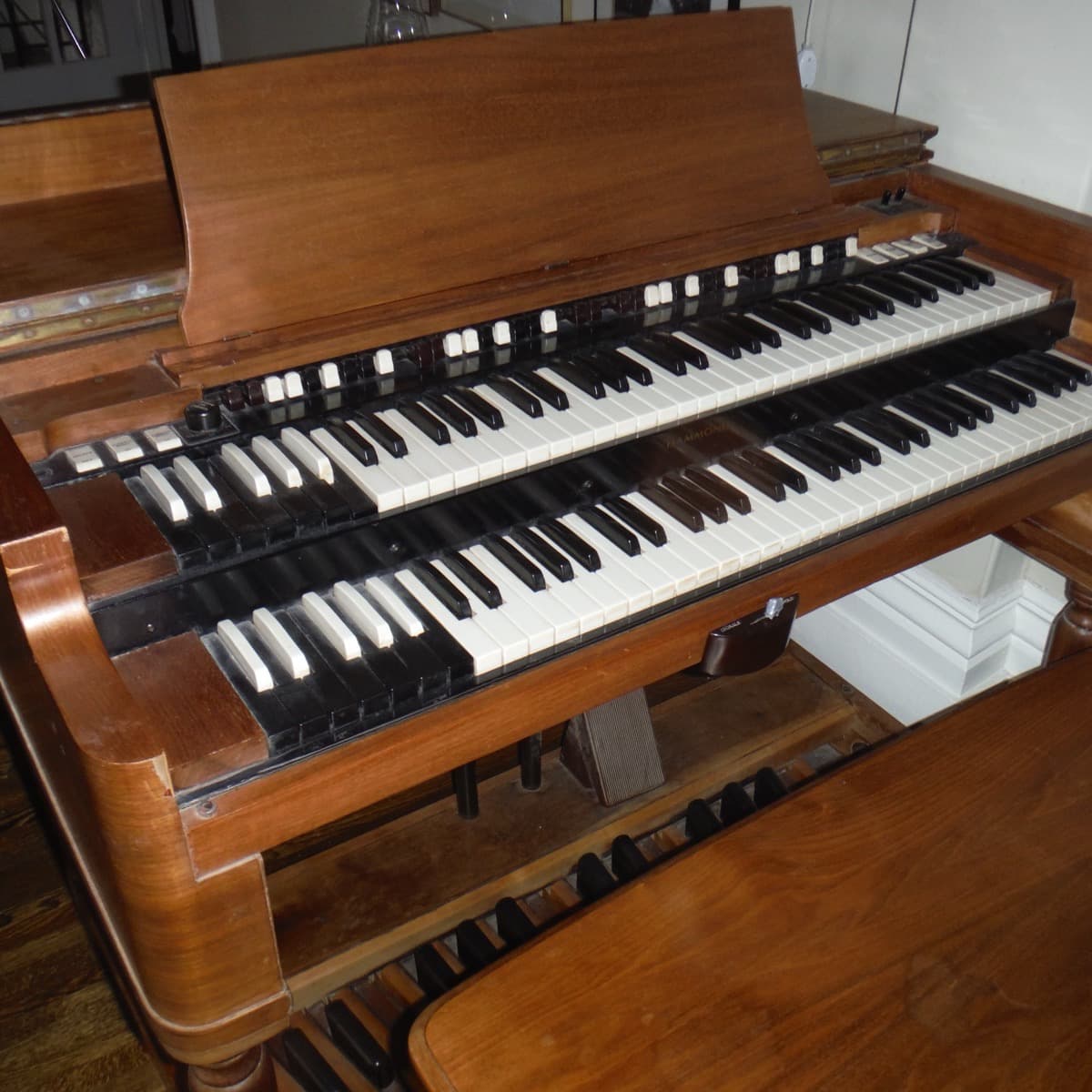
Sustained and built from stacked harmonics rather than a single waveform. Drawbars set the balance of those harmonics; harmonic percussion adds a decaying attack; key click gives each note a percussive edge. Most of the movement associated with the instrument comes from a Leslie rotating speaker rather than from the organ itself.
Getting the Hammond B-3 sound
Historical instrument ≠ modern equivalent. These are editorial suggestions for getting close, not claims about what was used on any recording.
IK Multimedia
Officially licensed virtual Hammond B-3, developed in cooperation with the Hammond Organ Company and Suzuki Musical Instruments. Models the tonewheel generator, the drawbars and a Leslie rotary cabinet.
Described by IK Multimedia as the first official Hammond B-3 virtual instrument, designed in cooperation with the Hammond Organ Company.
Arturia
Software emulation of the tonewheel organ and its Leslie rotary speaker, with modelled tonewheel leakage, drawbar leakage and key click.
Not licensed by the Hammond Organ Company — unlike IK Multimedia's B-3X, which is. Both model the instrument directly; only one carries the manufacturer's endorsement.
Metal tonewheels turn on a shaft driven by a synchronous motor, each passing in front of an electromagnetic pickup. The varying magnetic field induces a small alternating current close to a sine wave, and because every wheel is geared to the same motor all notes hold a constant pitch relationship to one another. Drawbars control how much of each harmonic reaches the output. Harmonic percussion, the feature the B-3 and C-3 introduced, adds a decaying second or third harmonic when a key is pressed.
Three models are routinely confused with the B-3. The C-3 is internally identical in a different cabinet. The M-3 is a smaller spinet with 44-note manuals rather than the B-3's 61. The A-100 is effectively a self-contained B-3 with its own amplifier and speakers.